Spiced chai: the slow morning kettle
On masala chai as it is actually made in Indian kitchens, with a kettle, whole spices, and a long unhurried boil.
The kettle in my mother’s kitchen in Bangalore is dented in three places and the handle is wrapped in a strip of cotton because the metal grew too hot to hold. This is the kettle for chai. Not a teapot. Not a stainless saucepan kept polished for guests. A blackened, working kettle that has boiled chai twice a day for thirty years.
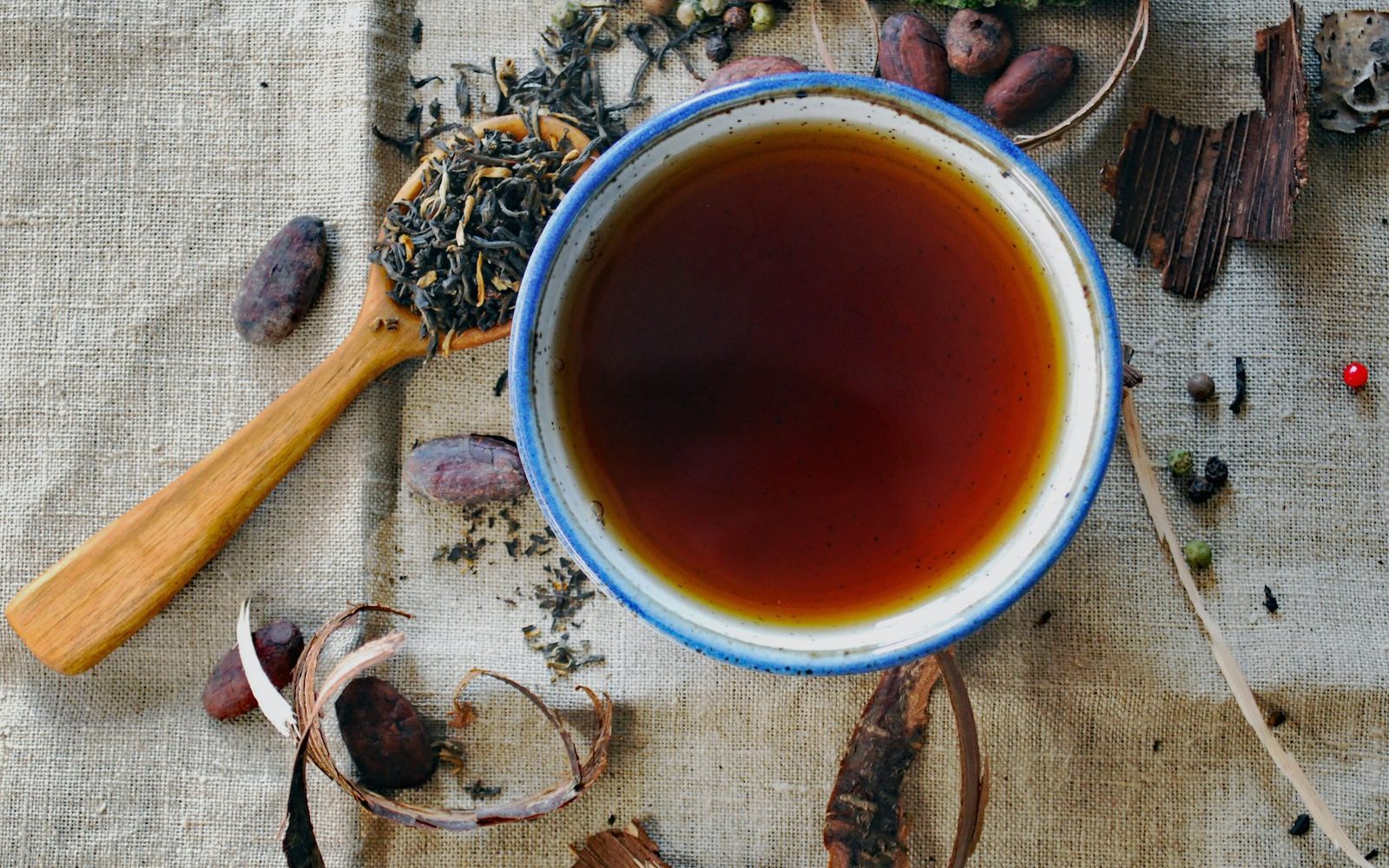
Real masala chai is not delicate. It is boiled, not steeped. The leaves are CTC black tea, small pellets that release a strong dark colour. The spices are whole, cracked between the fingers or pounded lightly in a small mortar. The milk is full fat. The sugar is whatever the household uses.
The word chai, and a small correction
In Hindi, in Bengali, in Urdu, the word chai simply means tea. To say “chai tea” in India is to say tea tea. Masala chai is the version with spices, and that is the cup most outside the country now think of as chai. Plain hot black tea with milk and sugar, no spices, is still chai in any Indian home; it is just a different chai.
This matters because Indian tea culture is more varied than the spiced version suggests. The street vendor in Kolkata may make a milkier, sweeter cup with little spice. The Punjab household may add only cardamom. The Tamil cup may run stronger and quicker. The masala chai of the popular imagination is largely the north Indian household style, with Kashmir and Gujarat playing variations.
The spices, in the order most homes use them
The base of a household masala chai is rarely a fixed recipe. It is a rough sequence. Green cardamom pods, cracked. A small piece of fresh ginger, grated or pounded. A few cloves. A short stick of cinnamon, often the softer cassia rather than true Ceylon. Sometimes a black peppercorn or two for body. Sometimes a pinch of star anise or fennel for sweetness.
These are not all used at once in every household. Some families use only ginger and cardamom. Others, especially in winter, will include all of the above. The proportions are not measured. The cook adds what looks right for the number of cups, often pressing the spices between thumb and forefinger to release the oils.
“My mother said chai is honest. You cannot hide cheap leaves with strong spices. The tea has to do its part.” (a kitchen note from a Lucknow household, 2014)
How the kettle works
Water is brought to a low boil with the spices and ginger. They simmer for two or three minutes, the kitchen filling with the warm, faintly peppery smell of cardamom and clove. CTC black tea is added next. The water turns a deep red-brown almost immediately. Milk is added, in a roughly one-to-one ratio with the water for a strong household cup. Sugar is added. The whole thing is brought back to a controlled boil.
The key, which separates an Indian household chai from most attempts elsewhere, is that the boil is repeated. The cook lets it rise, then turns the flame down before it spills, then lets it rise again. Three or four such boils are common. Each one deepens the colour and the flavour.
The strain
The chai is poured through a small steel sieve into the cups. The spent leaves and spices are usually composted, given to plants, or simply tossed. Some households save them for a second weaker brew later in the day, particularly if the morning batch was made strong.
The cup with the morning
Indian mornings, in most households, are paced. The newspaper. The first round of stretches or prayers. The puja, in religious homes, or the sweeping of the entrance. The chai sits inside this, often the first hot thing in the body. It is taken in a small steel tumbler or a ceramic cup, both hands wrapped around it if the morning is cool.
It is rarely a solitary drink. The chai round is for whoever is in the house. The kettle holds enough for three or four. A guest who arrives is immediately offered a cup. To say no is acceptable but unusual. Even on hot afternoons, a hot cup is the more common offer, on the older theory that warm drinks suit warm weather. Readers familiar with Ayurvedic basics will recognize the logic.
The evening chai
Many households do not stop at one round. There is often an evening chai around four or five, smaller in volume, taken with a biscuit or a slice of plain toast. The evening cup is sometimes weaker, sometimes the same as the morning. In winter, it may be slightly more cardamom-heavy.
This second round is part of the larger conversation about comfort and relaxation rituals in many Indian homes. The evening cup punctuates the transition between work and the slower part of the day. It is small enough not to disturb sleep, in most cases, and warm enough to slow the body down.
Regional differences worth knowing
Kashmir has its own pink salt tea, kahwa, which is quite different and more saffron-driven. Gujarat sometimes adds lemongrass, called sukku, to the kettle. South India tends toward sharper, less sweet brews, often without much spice. The Parsi households of Mumbai have a distinctive style using lemongrass and mint together.
None of these is more authentic than the others. The kettle in Bangalore makes one kind of chai. The kettle in Lahore makes another. Both are correct in their own kitchens.
A short word on care
Masala chai has caffeine from the black tea and can be quite strong in the household preparation. Pregnant women, people on certain medications, and those sensitive to caffeine may want to go gently, or speak with a qualified practitioner before making it a daily morning habit. The spices, particularly ginger and clove, can also be vigorous in large amounts.
The kettle, when the round is over, is rinsed but rarely scrubbed inside. A faint dark patina is considered part of its character. The cups are washed. The morning continues, slightly warmer than it was.
What is the difference between chai and masala chai?
Why is the tea boiled rather than steeped?
Can I make chai without milk?
The kettle is heavy in the hand. The cup is light. The morning, slowly, becomes the day.